
A version of this story was published in The Verge on February 26, 2016. This was my first submitted draft.
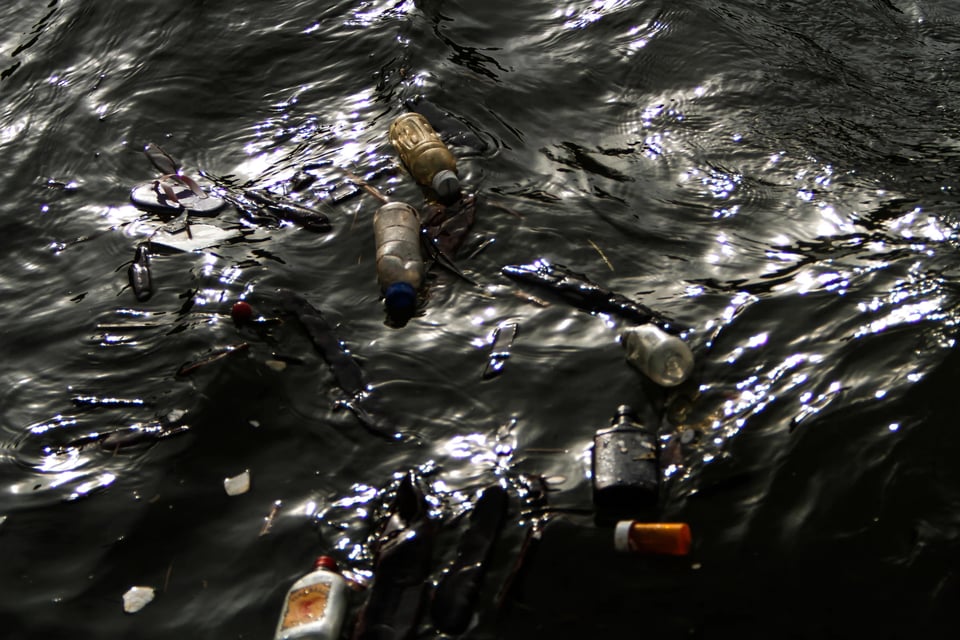
At 9AM on June 10, 1999, in Flint, Michigan, a subcontractor digging a trench to lay new telephone fiberoptic cable near an apartment complex along Beecher Rd between I-75 and the Flint River opened a 6-inch-wide, 5-foot-long gash in an unmarked 72-inch pipe running from the city’s sewers to the Flint Waste Water Treatment Plant in Flint Township. Sewage filled a pond in a nearby golf course until the pump to the crushed pipe was shut down, diverting the untreated water directly into the Flint River, upstream, near the Third Avenue bridge. Over more than two days, twenty-two million gallons of raw human, industrial, residential, and commercial waste poured into the river. The alternative was to let the waste back up into 15,000 homes. Even more was redirected into adjoining municipal and county sewer systems to relieve pressure while the pipe was repaired.
The weather was warm and the river was low, concentrating the contamination. Fearing a spread of Hepatitis A and other bacterial infections, Ken Hardin, the county drains commissioner, and James Helmstetter, the county’s director of environmental health, warned residents against any contact with the river between Third Avenue in Flint and its terminus in the Shiawassee, in Saginaw County. The next night, downstream in Mt. Morris Township, Karen Winchester saw hundreds of dead fish floating down the river past her property — catfish, carp, and bluegill, three to 20 inches long, all belly-up. Nearly a month later on July 1, still registering unsafe levels of bacteria on daily water tests throughout the river, city officials opened the floodgates on downtown Flint’s Hamilton Dam to try to wash the filth away.
Roese Contracting, the company responsible for the dig, blamed the city. It had contacted the water utility three times through a third party to have the water lines marked. City Administrator David H. Ready said his office hadn’t marked the line because water and sewer employees were busy working with General Motors on construction of a new engine plant at its Van Slyke Road complex. All of this was happening in the middle of the city’s negotiations to extend its then 32-year-old contract for water from Detroit, and as the city was under pressure from the state to prove that it could treat drinkable water from the Flint River in an emergency. It was also an election year.
For more than a year, health officials prohibited swimming, fishing, or direct contact with the river. (Health notices were not mailed out; officials explained the were counting on news media.) Bacteria levels would fall, then rise again, suggesting that waste was still being dumped illegally into the river.
In June 2000, the Michigan legislature passed a law requiring municipal and county authorities to report any sewage spill to the Department of Environmental Quality. As part of an amnesty program, nine communities in the Flint area reported 90 illegal sewage overflows over the past five years. Heavy, power outages, accidents at plants and along sewage lines repeatedly dumped waste into the river. Flint itself declined to disclose any spills it hadn’t already reported. Communities began doing house-to-house checks looking for illegal hookups dumping into the sewer system or the river. Many were never found.
Everyone lamented that the spill and its aftermath were undoing the thirty years of progress the city had made in making the river clean again. The Clean Water Act, annual clean-ups, education and outreach efforts led and funded by the very industries who’d done so much to damage the river’s reputation in the first place. It was a huge setback. As a silver lining, many of them repeated a version of the caveat Helmstetter added to his warning the day after the 1999 spill.
"As far as we know, no (community) uses the Flint River for a drinking water source,” he said.
Most of the contaminants now in Flint’s drinking water were introduced during or after processing. Chlorination produces trihalomethanes and other dangerous byproducts; acidic water corrodes metal pipes; stagnation anywhere along the line, which is especially a problem in a city built for 200,000 people shrunk to half that size, particularly after the city’s largest water customer leaves the system, raises the likelihood of bacteria and makes the water less safe to drink.
The river itself is polluted from four sources:
Natural biological waste from organisms in and near the river;
Treated industrial and human waste, diluted and released downstream for minimal impact;
Untreated waste dumped into the river, intentionally or accidentally;
Contaminants in the ground washed into the river by rain or snow.
For most of its history, Flint (like other cities) didn’t worry about any of these, even though they certainly ended up in the city’s drinking supply. Industrial waste was introduced into the Flint River with the first lumber mills in the 1830s, powered by the river. The lumber industry brought railroads. Lumber magnate Henry Crapo built the Flint and Holly railroad, became Flint’s mayor, and then governor of Michigan; as the trees were depleted and the lumber industry waned, his great-grandson William Crapo Durant went into the carriage business and eventually founded General Motors.
After lumber came the paper mills, to make use of the waste products of sewn lumber. But with paper and cardboard came chemical processing. “The paper mills have a definite odor. It’s kind of like rotten eggs,” said Virginia Landaal, who co-founded a cardboard packaging company with her husband Walter in Flint. That smell is burning sulfur, which was mixed with water and used to chemically process wood chips into pure cellulose. Until the 1930s, all of these chemicals were wasted and usually disposed of into the river.
That’s the context in which the auto industry begins. Chevrolet’s main plant in Flint, Chevy in the Hole, was built on the site of an old paper mill on the Flint River, just downstream where the city was drawing its drinking water.
Today, it’s an EPA brownfield site. After multiple environmental assessments and cleanups have been completed at the site since at least the 1980s, the factories were downsized one by one. The buildings were raised in 2004, and GM sold the site to the city of Flint for $1. Contaminants left behind include heavy metals like arsenic, mercury, and lead, toxic chemicals like ammonia and solvents, volatile organic compounds (VOCs), and polynuclear aromatics (PNAs) including petroleum compounds. In 2012, an EPA settlement absolved the city of its responsibility for pollutants at the site. The environmental profile at GM’s other former factories in Flint, like Buick City and Flint West, both EPA funded sites, is similar.
Between 1900 and 1930, Flint, led by General Motors, was experiencing its first boom, reaching 150,000 people. The city had been drawing its drinking and industrial water from the Flint River since 1893, and discharging its untreated waste downstream.
In the 1930s, the fish began to disappear — first in the Flint River, and then downstream in the Shiawassee and in Saginaw Bay. This was partly due to overfishing, but fish were being discovered dead with no obvious cause. In 1934, a Genesee County conservation officer named Ivan Kester sent seven fish on ice to the newly-formed Institute for Fisheries Research with a remarkable letter:
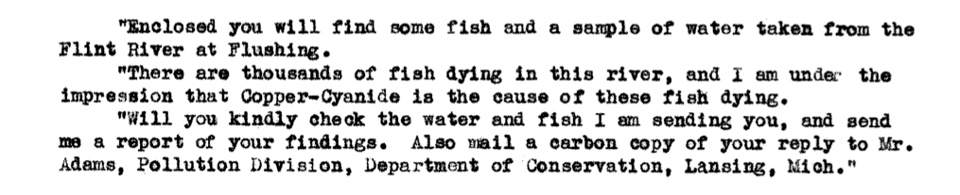
The institute determined that pollution had lowered oxygen levels in the river, suffocating them.
But environmental considerations were generally set aside during the Great Depression and World War 2. (Oral accounts later reference oil on the Flint River catching fire at least two different times in the 1930s, but these are not well-attested in the written record.) The once-plentiful stocks of walleye in the Flint River and Saginaw Bay completely collapsed by the 1940s, almost entirely as a result of polluted water poisoning incubating eggs.
After the war, Flint was booming again. GM, desperate to keep its level of production near wartime levels, produced more cars than ever. After the Flint Sit-Down Strike in 1936, unionization and collective bargaining drove up salaries, making Flint one of the most universally prosperous middle-class cities in the country. The city rapidly expanded, its boom corresponding precisely with the golden ages of lead solder piping and shitty record-keeping. Between 1945 and 1956, per capita water use grew from 56 to 81 gallons per day, while the city’s population had grown to nearly 200,000 people. Both of those numbers were projected to rise: more water, being used by more people, indefinitely into the future. New regulations forced GM and other businesses to treat and dilute their waste before releasing it into the river, again with city water. The medium-sized river could not keep up. In 1955, just a year after building a new $10 million water treatment plant, a report showed that the Flint River could not support the city’s residential and industrial needs.
The growth of industry and population also strained the limits of the city’s sewage treatment plants. After a series of reports, in 1960, the Michigan Water Resources Commission ordered Flint to “abate unlawful pollution of the Flint River… by February 1, 1963.” The need to properly treat municipal and industrial waste, as much if not more than the need to provide clean drinking water, forced Flint to stop using the Flint River and switch to water from Lake Huron. A plan to build a Flint-owned pipeline directly to the lake was abandoned when the Manufacturers Association of Flint, led by General Motors’ Edward D. Rollert and C.S. Mott, convinced the city it would be cheaper to join Detroit’s growing system, which had switched from the Detroit River to Lake Huron for similar reasons. The water was cleaner, colder, and tasted better, but those concerns were secondary to cost and capacity.
But switching to new drinking water did not end problems with the Flint River. Studies of the river in 1965, 1966, 1967, and 1969 all showed “poor water quality caused by numerous sources… [including] treated and untreated waste discharges in the City of Flint, the Flint Wastewater Treatment Plant (WWTP), and to a lesser extent the Flushing and Genesee County Sewage Disposal District #2 WWTP’s.” After the passage of the Clean Water Act in 1972, a 1974 study of the Flint River showed improvement upstream of the city but significant toxins downstream. Raw sewage discharges from Flint’s wastewater plant raised fecal coliform bacteria; phenol from GM and Buick and ammonia from the wastewater plants contributed toxic materials.
Heavy use of fertilizers in the rural areas upstream of the city also polluted the river. A 1975 EPA study of Holloway Reservoir showed that phosphates from fertilizers and detergents had turned the reservoir eutrophic — stimulating algae growth to the point of collapsing oxygen levels, turning the water cloudy and brown. Official landfills (like one in Richfield Township, now a toxic cleanup site) and unofficial ones (like one on Bray Road, only cleaned up in 2014 so the city could use it to dump its own wastewater sludge there) all polluted the grounds and groundwater. While environmental regulations kept companies from dumping waste into the river directly, illegal dumping was rampant. In 1990, a furniture salesman was convicted of dumping industrial amounts of toxins onto his property on the banks of the river. There are dozens of stories like this.
Finally, in the 1980s, with nearly all of its Flint plants in noncompliance or potential noncompliance with EPA regulations, and facing significant costs to upgrade costs to bring those now 80-year-old facilities in line with current environmental and manufacturing standards, General Motors began to draw own its presence in Flint. GM employment went from a peak of 82,186 in 1955 and 62,598 in 1985 to 43,399 in 1992, 33,000 in 1998, 12,000 in 2005, and about 7,200 today. Associated industries, from metal treatment to packaging, all suffered. That economic collapse led to decaying properties, lower revenues for services, and ultimately an emergency manager being appointed to the city. It all trickled down.
The Flint Water Crisis did not begin on April 25, 2014, when the city switched its water supply from Detroit’s system tapping Lake Huron to its own on the Flint River. It did not begin in June 2014 after the first outbreak of Legionnaire’s Disease tied to legionella bacteria in the water. It did not begin in August and September 2014, when the city issued system-wide boil-water advisories after blowing tests for coliform bacteria and carcinogenic trihalomethanes (THMs) in its water supply. It did not begin when, to bring the bacterial and THM levels below legal limits, water treatment officials added extra chlorine to the already acidic water and neglected recommendations to add a phosphate corrosion inhibitor, causing the water to leach lead and other contaminants from older pipes throughout the system. It did not begin in October 2014 when GM stopped using Flint city water in its factories after observing it was corroding automotive parts and machinery. It did not begin on Feb. 18, 2015 when Lee Anne Walters detected lead levels of 104 parts per billion in her home, leading to an EPA investigation by Miguel Del Toral, or when a second test performed without first flushing the pipes registered lead at 397 parts per billion. It did not begin in June 2015, when the ACLU made a documentary titled “Hard to Swallow” featuring complaints about Flint’s water by citizens, activists, and local leaders. It did not begin in August 2015 when a team of Virginia Tech researchers led by Marc Edwards, Amy Pruden, and Joseph Falkinham III began testing water in Flint, and it did not begin on Sept. 24, 2015 when Dr. Mona Hanna-Attisha released data showing rising lead levels in Flint’s children. The crisis did not begin when state and local officials repeatedly assured citizens that the water was safe to use and drink. And it did not end when the same officials finally admitted that the city’s water was dangerously toxic and switched back to the older water system, with much of the damage to people and infrastructure now unfixable.
Flint’s Water Crisis is an ongoing disaster caused by greed, politics, incompetence, and selective amnesia. Like groundwater draining into the river, it’s unearthing contaminants that were buried decades ago. It is part of a series of environmental disasters specific to Flint, but echoed by similar crises in other towns and cities all over the world.
We only know part of its history, but the more we know, the more Flint somehow looks both avoidable and inevitable. This disaster could have been averted or lessened, but something like it was going to strike somewhere; it happened in Flint. We only know a fraction of its full consequences for the future, and what we know is terrifying. This series of stories, from Michigan and beyond, explores that history and those futures.
As a man-made environmental disaster, the Flint Water Crisis has few analogies or precedents. “Governor Snyder called Flint his Katrina,” a political aide told me. “But it's really more like a Chernobyl.”
SOURCES:
* The archives of the Flint Journal
* Sloan Museum exhibit, “Water’s Extreme Journey,” January 23 — May 8.
* Flint River study, August 6-7, 1974. [Lansing] : State of Michigan, Dept. of Natural Resources, Environmental Protection Bureau, 1977.
History, Status, and Managment of Fishes in Saginaw Bay, Lake Huron, 1891-1986.
* Report on Holloway Reservoir, Genessee and Lapeer Counties, Michigan, EPA Region V, Working Paper No. 197.
You just read issue #185 of Backlight. You can also browse the full archives of this newsletter.


